Why Every Additional Drop Matters in High-Recovery Water Treatment
Every Drop Has a Cost
Global water scarcity is changing how industries think about water. In the past, the primary objective of water treatment was simple: use water, treat it, and discharge it. Today, the challenge is no longer centered solely on compliance. It is increasingly about how efficiently limited water resources can be utilized, reused, and preserved.
According to the UN World Water Development Report 2024, roughly half of the world’s population experiences severe water scarcity for at least part of the year, while industry accounts for just under 20% of global freshwater withdrawals.
For industrial operations, water carries a cost at every stage. There is the cost of sourcing water, the cost of treating wastewater, and in Zero Liquid Discharge (ZLD) systems, the significant cost of evaporating and crystallizing concentrate streams. The economic impact of water extends far beyond the treatment system itself.
Ultimately, industrial water treatment comes down to one question: how much water can be reused, and how much wastewater can be avoided.
Higher Reuse Creates New Challenges
The further industries push water reuse, the more demanding the treatment challenge becomes.
As more water is recovered as usable output, salts and dissolved constituents become increasingly concentrated in the remaining stream — raising osmotic pressure, reducing the driving force available for permeate production, and intensifying fouling, scaling, and concentration polarization near the membrane surface. In many systems, this translates into higher pressure requirements, increased energy consumption, and greater operational complexity.
Studies of RO concentrate treatment in ZLD systems have identified scaling and fouling as key factors affecting energy consumption, permeate flux, and overall ZLD performance.
Yet this challenge also creates an opportunity. Every additional cubic meter of water diverted away from the concentrate stream reduces the wastewater volume moving downstream — and in advanced treatment systems, that reduction often translates directly into lower operating costs.
Two Technologies. One Objective.
Addressing this challenge requires more than a single membrane technology.
Water reuse systems face very different operating conditions as water moves through the treatment process. Early stages demand operational stability and fouling resistance. Later stages must handle increasingly concentrated streams that push conventional membrane systems to their limits.
Recent research into membrane technologies for ZLD and MLD highlights water recovery, brine management, energy efficiency, fouling, and scaling among the key considerations in advancing these systems.
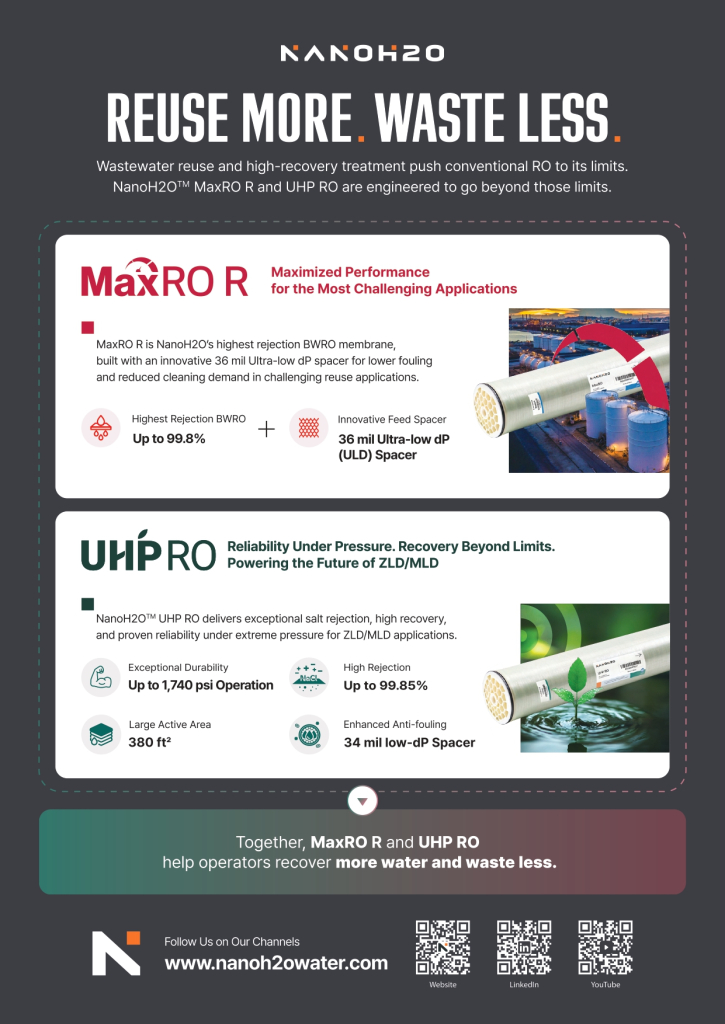
NanoH2O addresses these challenges through a complementary technology portfolio. NanoH2O™ MaxRO R is designed to support reliable and efficient operation in demanding water reuse applications, while NanoH2O™ UHP RO is designed to extend membrane treatment into highly concentrated streams, where additional water extraction can significantly reduce downstream treatment requirements.
Together, these technologies support water recovery across multiple stages of the treatment train, helping operators maximize water utilization before disposal becomes necessary.
Different applications. Different operating conditions. One objective: extract more value from every drop of water entering the system.
MaxRO R: The Value of Stable Operation
One of the largest hidden costs in industrial water reuse systems is unplanned performance decline. Increasing differential pressure and fouling lead to higher operating pressures, more frequent cleaning events, increased energy consumption, and greater operational burden over time.
NanoH2O™ MaxRO R combines 99.8% stabilized salt rejection with an industry-first 36 mil Ultra-Low Differential Pressure feed spacer, designed to optimize feed-channel hydraulics.
By improving feed-channel hydraulics, the ULD feed spacer helps maintain more uniform flow distribution across the membrane surface. This can reduce stagnant zones where foulants tend to accumulate and support more stable operation over time.
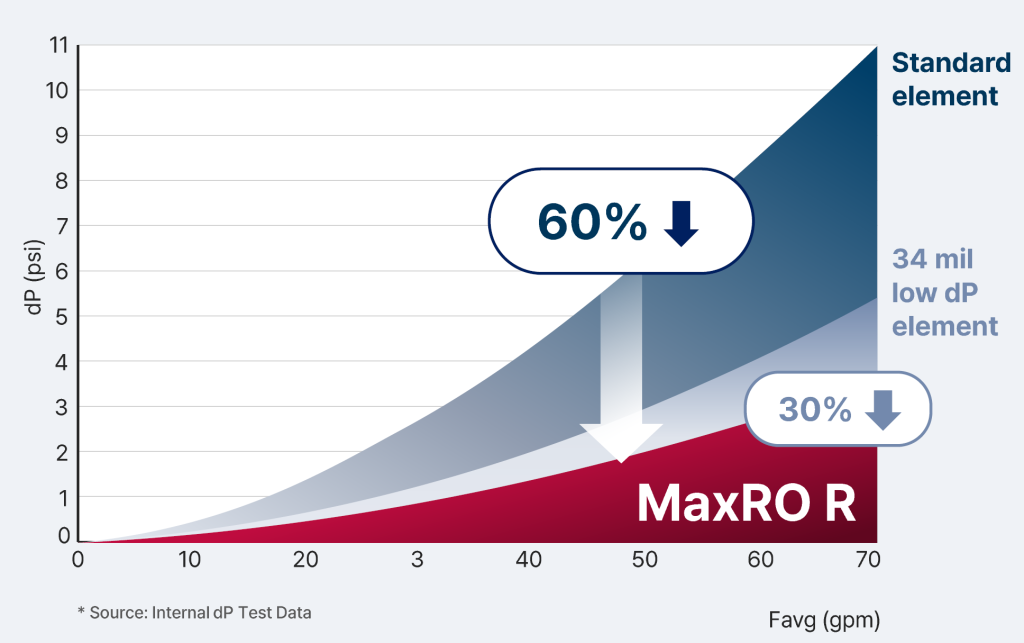
Source: NanoH2O Internal dP Test Data
In internal testing, MaxRO R demonstrated up to 60% lower differential pressure than conventional spacer designs. This advantage held up in the field as well: in an industrial semiconductor wastewater reuse project, MaxRO R showed a slower increase in differential pressure and reduced fouling tendencies compared with conventional low-dP spacer designs.
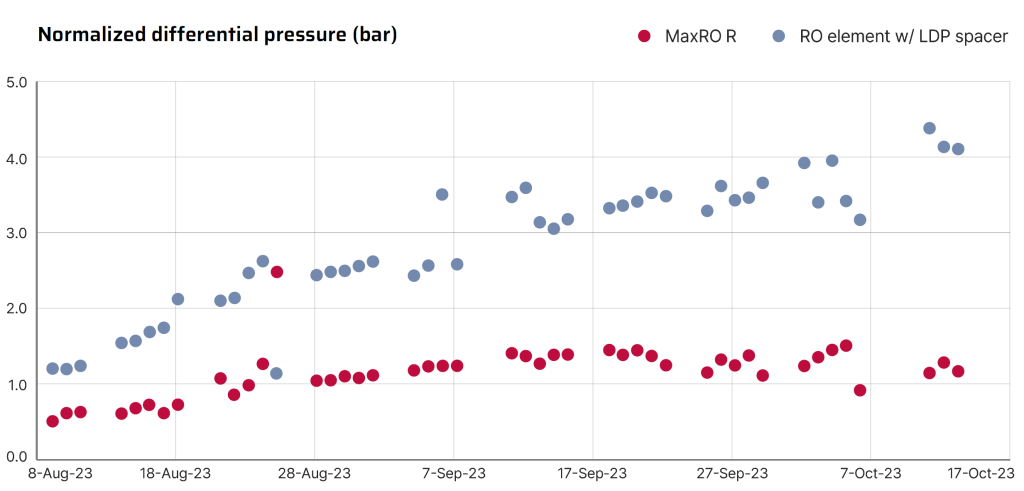
Source: NanoH2O Industrial Wastewater Reuse Field Test
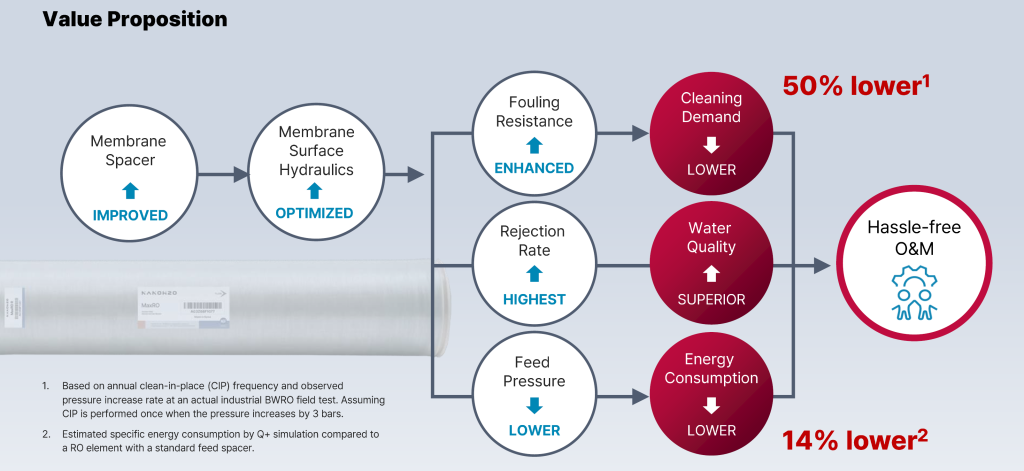
That advantage translates directly into operational impact — lower differential pressure reduces operating burden, decreases cleaning requirements, supports lower energy consumption, and contributes to greater long-term reliability.
Ultimately, MaxRO R’s value goes beyond membrane performance — it lies in helping lower the total cost of ownership of water reuse systems through stable, predictable operation.
UHP RO: Reducing the Cost of Concentrate
A different challenge emerges as streams become increasingly concentrated. Once conventional RO systems reach their practical operating limits, the remaining concentrate is typically sent to thermal treatment processes such as evaporators and crystallizers — often among the most energy- and capital-intensive components of a ZLD system.
Research into industrial RO concentrate treatment notes that evaporation-crystallization is widely used to achieve ZLD, while its high energy requirements can create economic and environmental challenges.
In many cases, the most expensive water in the entire treatment train is no longer the feed water. It is the concentrate waiting for thermal treatment.
NanoH2O™ UHP RO is designed to address this challenge. At these concentration levels, osmotic pressure can approach the practical operating limits of conventional RO systems. Ultra-high-pressure operation provides the additional hydraulic driving force necessary to continue separating water from streams that would otherwise require direct thermal treatment.
Operating at pressures up to 120 bar (1,740 psi), UHP RO extends membrane treatment into ultra-concentrated streams, enabling additional water extraction before thermal processes become necessary.
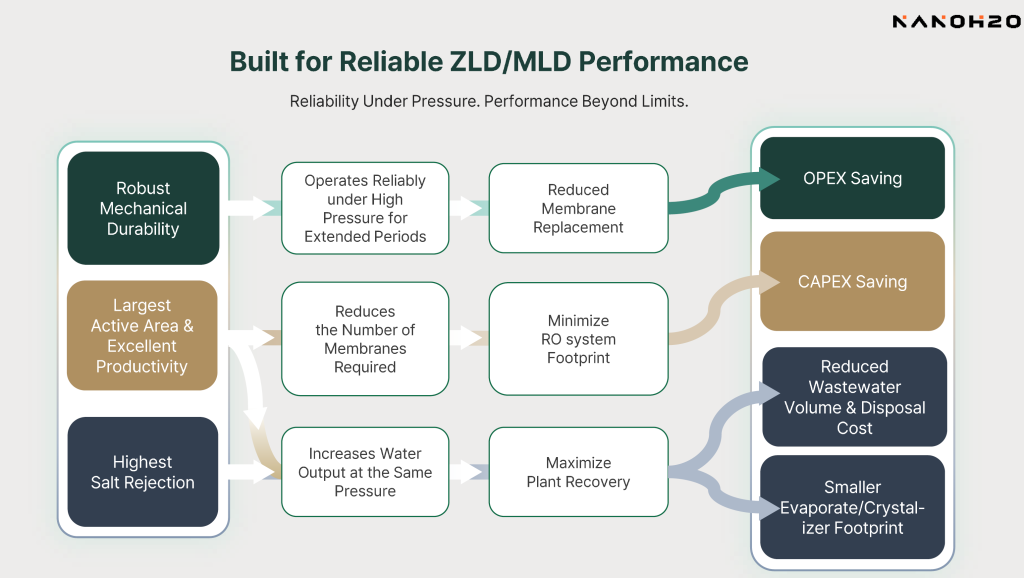
It also delivers 99.85% stabilized salt rejection, 8,500 GPD of permeate flow, and 380 ft² of active membrane area — making it, across pressure tolerance, rejection, and productivity alike, one of the highest-specification UHP RO products available in the market today. In comparative differential-pressure testing across various flow conditions, it also showed 60% lower differential pressure than the competitor UHP RO element evaluated, confirming that its advantage extends beyond pressure rating alone to stable, reliable operation.
This capability creates value well beyond the additional permeate it produces — its greatest impact is reducing concentrate volume.
Because thermal processes are generally among the most energy-intensive stages of a ZLD system, reducing concentrate volume can help lower energy consumption and downstream treatment requirements.
Every cubic meter of water recovered upstream can reduce the flow sent to downstream evaporation and crystallization systems — lowering energy consumption, reducing disposal requirements, shrinking equipment footprint, and improving overall plant economics.
In this way, UHP RO delivers value beyond recovery performance alone — it helps reduce the volume of water sent to the most expensive stage of the treatment process.
Looking at the System as a Whole
Sustainable industrial water treatment cannot be defined by a single performance metric.
High salt rejection matters. Low differential pressure matters. High water production matters.
Viewed technically, maximizing system performance requires balancing membrane productivity, salt rejection, fouling control, hydraulic efficiency, and downstream treatment requirements rather than optimizing any single parameter in isolation.
But customers ultimately evaluate success at the system level: how much water can be reused, how much wastewater can be reduced, how much energy is consumed, and how economically the plant can operate.
Viewed from this perspective, MaxRO R and UHP RO address different parts of the same challenge. MaxRO R improves operational efficiency by minimizing fouling-related burdens and supporting stable long-term operation. UHP RO improves system economics by reducing the volume of concentrate requiring downstream thermal treatment.
Together, they help operators increase water utilization, reduce waste, and improve the economics of high-recovery treatment systems.
Reuse More. Waste Less.
The future of industrial water treatment will be defined by how much value can be extracted from every drop before it becomes waste.
NanoH2O™ MaxRO R and UHP RO address different challenges across the treatment train — from operational stability in water reuse systems to concentrate reduction in high-recovery ZLD and Minimal Liquid Discharge (MLD) applications. Together, they help facilities maximize water utilization while reducing downstream treatment burdens.
In high-recovery systems, success comes from two things together: how much water is recovered, and how much costly wastewater treatment is avoided downstream.
More water reused. Less wastewater generated. Less cost sent downstream.
Reuse More. Waste Less.
That is how NanoH2O is helping advance the next generation of high-recovery water treatment.